

From Test Results to Asset Decisions: Turning Cable Diagnostics into Effective Maintenance Strategies
/
This article draws on technical material presented by Mark Fenger, Senior Technical Director for HV Cables, and the Kinectrics technical team during Cable IQ 2026, a Power Knowledge Sessions event hosted by Composite Power Group in Calgary on November 5, 2026.

Power cable diagnostic testing provides utilities with valuable information about the condition of their electrical infrastructure. However, collecting test results is only the beginning. The real value comes from understanding what those results mean and using them to make informed decisions about maintenance, repair, monitoring, and replacement.
A cable that passes a dielectric withstand test is not necessarily free from defects. Similarly, an abnormal diagnostic measurement does not automatically mean that a cable must be replaced.
Different testing methods reveal different aspects of cable condition, and their results must be interpreted in the context of the cable's construction, operating history, environment, and importance to the electrical network.
For utilities managing aging infrastructure, the challenge is to translate technical measurements into practical asset management decisions while balancing reliability, safety, operational risk, and cost.
This article explores how cable diagnostic information can support condition assessment, risk evaluation, maintenance planning, and long-term investment decisions for medium-voltage (MV), high-voltage (HV), and extra-high-voltage (EHV) cable systems.
1. Understanding the Difference Between Testing and Asset Management
Cable testing and cable asset management are closely related, but they serve different purposes. Testing provides information about the electrical or physical condition of a cable system. Asset management uses that information, together with operational and economic considerations, to determine what action should be taken. For example, partial discharge testing may identify localized electrical activity near a cable joint. The test itself does not determine whether the utility should immediately replace the joint, conduct further investigation, or continue operating the circuit under closer observation. That decision requires additional information.
Questions That Influence Asset Decisions
Utilities may need to consider:
What type of defect is suspected?
Where is the defect located?
How severe is the condition?
Is the condition stable or deteriorating?
How critical is the circuit?
What are the consequences of an unexpected failure?
Can the defect be repaired locally?
What is the cost and operational impact of intervention?
How confident are engineers in the diagnostic evidence?
The answers help determine whether a cable should remain in service, undergo further testing, receive targeted repairs, or be scheduled for replacement.
The purpose of cable diagnostics is not simply to identify abnormalities, but to provide evidence that supports better engineering and asset management decisions.
2. Begin With the Decision, Not the Test
One of the most important principles of effective cable condition assessment is establishing the objective before selecting a testing method. Different questions require different forms of evidence.
Commissioning Acceptance
For a newly installed cable, the primary question is whether the completed system is suitable for energization. Testing may focus on dielectric withstand capability, installation-related defects, and accessory workmanship.
Fitness for Continued Service
For an aging cable, the question may be whether the insulation remains sufficiently reliable to support continued operation. This requires consideration of aging mechanisms, operating conditions, and diagnostic evidence.
Fault Localization
When a defect is suspected, testing may be intended to identify its location so that corrective action can be targeted.
Condition Monitoring
For assets already known to exhibit deterioration, repeated measurements may help determine whether the condition is changing.
Replacement Planning
For aging cable networks, condition assessment may support decisions about which circuits should receive priority for rehabilitation or replacement. These objectives should not be treated as interchangeable. A test suitable for commissioning a newly installed cable may not be the most appropriate method for evaluating an aged cable with suspected water-tree deterioration. Likewise, a method that provides information about general insulation condition may not be sufficiently sensitive to identify a localized defect at a joint.
3. Understanding What Diagnostic Results Actually Tell Us
No single cable diagnostic method provides a complete picture of insulation condition. Each technique measures a particular electrical characteristic or evaluates a specific aspect of system performance.
Dielectric Withstand Testing
A dielectric withstand test applies a specified voltage for a defined period to determine whether the cable system can tolerate the applied electrical stress. A successful result demonstrates that the system satisfied the withstand requirements under those test conditions. However, the test does not necessarily identify defects that survive the applied voltage.
Partial Discharge Testing
Partial discharge (PD) testing identifies localized electrical activity that may be associated with defects in insulation, joints, or terminations. It can provide valuable information about localized problems, particularly those involving electrical stress concentrations or defective dielectric interfaces. However, not all defects produce detectable partial discharge.
Tan Delta Testing
Tan delta testing evaluates dielectric losses within the insulation system. It can help characterize broader insulation deterioration, including certain moisture-related aging mechanisms. However, because the measurement represents the dielectric response of the tested system, localized defects may have little influence on the overall result.
Jacket and Sheath Integrity Testing
Jacket and sheath testing can help identify damage to protective components that may expose a cable to moisture or other environmental hazards. These tests address different concerns from those associated with the main insulation.
Comparing Diagnostic Methods
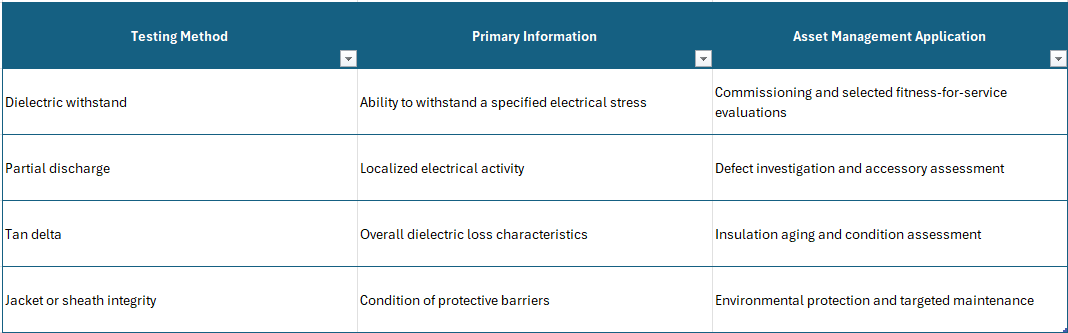
These methods are complementary. A cable may produce acceptable results using one method while exhibiting abnormalities using another. The challenge is to interpret the combined evidence rather than relying on a single measurement.
4. Why a Passing Test Does Not Guarantee Cable Reliability
A successful test result can provide confidence, but it should not be interpreted as proof that a cable system contains no defects. Consider a cable that successfully completes a dielectric withstand test. The cable has demonstrated that it can tolerate the specified voltage for the required duration. However, it may still contain a localized imperfection that did not develop into a complete breakdown during the test. If that imperfection produces partial discharge during operation, progressive deterioration may occur. Similarly, a cable containing water-tree degradation may continue operating normally despite having reduced insulation withstand margin.
The Difference Between Passing and Being Defect-Free
A passing result demonstrates compliance with the acceptance criteria of a particular test.
It does not necessarily establish:
The absence of localized defects
The remaining service life of the cable
The future rate of deterioration
The probability of failure under every operating condition
This distinction is especially important when interpreting results from aging infrastructure.
A passing test is evidence of performance under defined conditions, not a guarantee of future reliability.
5. Can Testing Damage an Aging Cable?
An important consideration when assessing older cable systems is whether the testing process itself introduces unacceptable risk. Dielectric withstand testing deliberately subjects insulation to elevated electrical stress. For a healthy cable system, an appropriately selected test should be consistent with the relevant testing requirements. However, aged insulation may contain defects that have reduced its ability to withstand elevated voltage.
The Risk of Breakdown During Testing
A severely degraded cable may fail when subjected to a withstand test. This creates an important operational question. Is it preferable to expose a weakness during a planned maintenance outage, or could the test cause a failure that the utility is not prepared to manage? The answer depends on the condition of the asset, the testing objective, and the consequences of failure.
Monitored Withstand Testing
Monitored withstand testing combines applied electrical stress with diagnostic measurements. For example, partial discharge activity may be monitored while the test voltage is applied. This can provide additional information about developing electrical activity before complete breakdown occurs. However, monitoring cannot guarantee that failure will be prevented.
Selecting an Appropriate Strategy
For aging cable systems, engineers should consider:
Insulation type and construction
Previous test results
Known deterioration mechanisms
Test voltage and waveform
Test duration
Operational consequences of failure
Availability of repair resources
Testing should be planned around the information required and the risk the utility is prepared to accept.
6. Interpreting Abnormal Results: Not Every Defect Requires Replacement
An abnormal diagnostic measurement indicates that further evaluation may be necessary. It does not automatically mean that the entire cable system has reached the end of its useful life. The significance depends on the type, location, and extent of the suspected defect.
Localized Defects
Suppose partial discharge testing identifies electrical activity associated with a particular cable joint. Further investigation may determine that the problem is limited to the accessory. In this situation, replacing or repairing the defective joint may restore acceptable system performance without replacing the entire cable circuit.
Distributed Insulation Deterioration
Consider an aging medium-voltage circuit exhibiting diagnostic characteristics consistent with widespread water-tree degradation. If deterioration is distributed throughout the insulation, replacing an individual joint may not address the underlying condition. The utility may instead need to consider continued monitoring, rehabilitation where technically appropriate, or cable replacement.
Uncertain Results
Some measurements may be difficult to interpret because of electrical interference, measurement sensitivity, or incomplete information. In these situations, additional testing may be more appropriate than immediate intervention. The important distinction is between identifying an abnormality and establishing its engineering significance.
7. The Importance of Defect Location
Knowing that a cable contains a defect is useful. Knowing where that defect is located can be considerably more valuable. Fault localization can determine whether the problem involves the main cable insulation, a joint, a termination, or another component.
Why Location Changes the Decision
Consider two cable systems exhibiting abnormal partial discharge activity. In the first system, the activity is localized to a single accessible joint. In the second, evidence suggests deterioration distributed throughout a long cable section. Although both systems exhibit abnormal measurements, the appropriate maintenance response may be very different.
Targeted Repair
When a defect is confidently localized, the utility may be able to:
Excavate a specific location
Replace a defective joint
Repair a damaged section
Correct an accessory installation problem
Retest the affected circuit
This can avoid unnecessary replacement of otherwise serviceable infrastructure.
Challenges in Fault Localization
Localization accuracy depends on several factors, including cable length, signal attenuation, measurement equipment, and electrical interference. For long cable systems, diagnostic signals may become weaker or distorted as they travel. Additional sensors or measurement locations may be required. The reliability of the location estimate should be considered before planning physical intervention.
8. False Positives, False Negatives, and Diagnostic Confidence
Diagnostic testing is subject to uncertainty. A measurement may suggest a problem that is not actually present, or a real defect may remain undetected. These possibilities have important consequences for asset management.
False Positives
A false positive occurs when a diagnostic result incorrectly indicates a defect or unacceptable condition.
Potential consequences include:
Unnecessary excavation
Avoidable cable replacement
Additional testing costs
Unplanned maintenance activities
Disruption to customers
False Negatives
A false negative occurs when a defect is present but the test does not identify it.
Potential consequences include:
Continued operation of a deteriorating asset
Unexpected cable failure
Extended outages
Emergency repair costs
Increased safety or operational risk
Why Measurement Conditions Matter
Diagnostic confidence can be influenced by:
Electrical noise
Sensor placement
Test waveform and frequency
Applied voltage
Cable length
Measurement sensitivity
Insulation material
Interpretation methods
For example, partial discharge testing may be highly useful for identifying certain localized defects, but a poor measurement arrangement can reduce sensitivity. Similarly, tan delta measurements may be effective for assessing broader insulation deterioration while providing limited information about a small localized defect.
Improving Confidence
When the consequences of a decision are significant, utilities may benefit from combining multiple sources of evidence. These may include diagnostic measurements, operating history, previous failures, inspection results, and additional testing.
A reliable asset decision requires not only a test result, but also an understanding of how much confidence can reasonably be placed in that result.
9. Why Cable Construction Affects Diagnostic Interpretation
Different insulation systems can exhibit different electrical characteristics. Consequently, diagnostic results should not be interpreted without considering cable construction.
XLPE-Insulated Cables
Cross-linked polyethylene (XLPE) is widely used in modern power cable systems. Its dielectric properties and aging behaviour influence the interpretation of diagnostic measurements. Older XLPE cable systems may exhibit moisture-related deterioration, while modern constructions incorporate materials and manufacturing practices intended to improve long-term performance.
EPR-Insulated Cables
Ethylene propylene rubber (EPR) insulation has different dielectric characteristics from XLPE. These differences can influence measured dielectric losses and the interpretation of tan delta results.
Why Universal Thresholds Can Be Misleading
A diagnostic value that is unusual for one insulation system may not have the same significance for another. The cable's age, material formulation, voltage class, and test conditions all matter. For this reason, condition assessment should use evaluation criteria appropriate to the particular cable system and testing method. Applying a single threshold to every cable can produce misleading conclusions.
10. Comparing New and Aging Cable Systems
The age and operating history of a cable influence both the defects likely to be present and the appropriate testing strategy.
Newly Installed Cable Systems
Commissioning primarily seeks to identify defects introduced during manufacturing, transportation, installation, and accessory assembly.
Examples include:
Insulation damage
Contamination at joints
Improper stress-control installation
Mechanical damage
Defective terminations
Localized defects are therefore an important concern.
Aging Cable Systems
Condition assessment of older cables may focus on deterioration that develops during operation.
Examples include:
Water-tree aging
Thermal deterioration
Electrical treeing
Accessory degradation
Moisture ingress
Repeated mechanical or thermal stress
These conditions may require different diagnostic methods and interpretation criteria.
Why the Difference Matters
A diagnostic strategy optimized for detecting installation workmanship defects may not adequately characterize widespread insulation aging. Similarly, a method suitable for assessing bulk dielectric deterioration may not identify a localized defect in a newly installed termination. Testing must reflect the expected failure mechanisms and the decision being made.
11. Evaluating the Consequences of Cable Failure
Cable condition is only one component of asset risk. The consequences of an unexpected failure can be equally important. Two cables with similar diagnostic results may require different maintenance priorities if their roles within the electrical network are different.
Factors Affecting Failure Consequences
These may include:
Customer Impact
How many customers or facilities would be affected by an outage?
System Redundancy
Can electrical supply be maintained through alternative circuits?
Repair Complexity
Would a failure require excavation, specialized accessories, or difficult site access?
Outage Duration
How long might restoration take?
Safety and Environmental Considerations
Could failure create significant safety hazards or environmental consequences?
Operational Importance
Does the cable serve critical infrastructure, industrial operations, or essential services?
Condition vs. Criticality
A cable in relatively poor condition may present manageable operational risk if redundancy is available and repairs are straightforward. Conversely, a cable exhibiting only moderate deterioration may deserve greater attention if its failure would cause severe disruption. This distinction is central to risk-based asset management.
Maintenance priority should reflect both the likelihood of failure and the consequences if failure occurs.
12. Translating Diagnostic Results Into Risk
A practical asset management approach considers cable condition alongside operational criticality. At a conceptual level:
Risk = Likelihood of Failure × Consequence of Failure
In practice, determining these factors can be complex. Diagnostic measurements do not automatically provide a numerical probability of failure. Instead, they contribute evidence that may help estimate relative condition or failure likelihood.
Evaluating Condition
Condition assessment may consider:
Diagnostic test results
Cable age and construction
Previous failures
Operating history
Environmental exposure
Known defects
Changes in measurements over time
Evaluating Consequences
Consequence assessment may consider:
Customer interruption
System redundancy
Repair cost
Restoration time
Safety implications
Operational importance
Combining the Information
The resulting assessment can help utilities prioritize further investigation, maintenance, and capital investment. For example, an aging cable with significant diagnostic abnormalities and high operational criticality may warrant earlier intervention than a similar cable serving a less critical application. However, such prioritization should be based on an established engineering framework rather than an arbitrary numerical score.
13. Choosing Between Monitoring, Repair, and Replacement
Once diagnostic evidence and operational risk have been evaluated, utilities must determine the appropriate response. Several options may be available.
Continue Normal Operation
If testing provides no significant evidence of deterioration and operational risk is acceptable, continued operation may be appropriate. The asset should remain within the utility's normal maintenance program.
Increase Monitoring
If a cable exhibits abnormalities that do not justify immediate intervention, additional monitoring may help determine whether the condition is changing. This may include periodic diagnostic testing or other condition assessment activities.
Conduct Further Investigation
When results are uncertain, additional testing may be necessary. This can help distinguish between genuine defects, measurement interference, and conditions that do not require corrective action.
Perform Targeted Repair
When a defect is localized, replacing a joint, termination, or damaged cable section may be sufficient. This approach can preserve serviceable infrastructure while addressing the identified problem.
Plan Cable Replacement
Replacement may be appropriate when deterioration is extensive, reliability is unacceptable, or continued maintenance is no longer economically practical.
Prioritize Immediate Intervention
Where evidence indicates a serious defect and the consequences of failure are substantial, urgent action may be necessary. The appropriate response depends on engineering judgment, available evidence, and the utility's operating requirements.
14. Using Diagnostic Trends to Support Maintenance Planning
A single diagnostic measurement provides information about cable condition at a particular point in time. Repeated measurements may provide additional insight into how that condition is changing.
Establishing a Baseline
Commissioning measurements can provide useful reference information for future testing. For aging assets, an initial condition assessment may establish a baseline for subsequent comparison.
Monitoring Changes
Changes in diagnostic characteristics may indicate evolving insulation condition. Examples include:
Increasing dielectric losses
Changes in partial discharge activity
Changes in partial discharge inception voltage
Newly detected localized abnormalities
However, comparisons must account for differences in test conditions.
Consistency Is Essential
Measurements taken using different equipment, waveforms, frequencies, or voltage levels may not be directly comparable. Environmental conditions and measurement arrangements can also influence results. For meaningful trend analysis, utilities should maintain consistent procedures and document test conditions.
Limitations of Trending
Not every defect develops gradually. Some failure mechanisms may progress rapidly or remain undetected until breakdown. Therefore, stable diagnostic measurements do not guarantee that an asset will remain reliable indefinitely. Trending should be considered one source of evidence within a broader condition assessment program.
15. The Role of Forensic Analysis After Cable Failure
When a cable fails, determining the root cause can provide valuable information for future asset management decisions. However, the location of electrical breakdown does not necessarily identify the original cause.
Possible Sources of Failure
A failure may originate from:
Manufacturing imperfections
Installation-related mechanical damage
Poor accessory workmanship
Moisture ingress
Electrical or thermal aging
Operating conditions outside design assumptions
Why Root-Cause Identification Can Be Difficult
The final electrical breakdown may produce extensive secondary damage. This can obscure the original defect. For example, a mechanically damaged insulation interface may initiate partial discharge activity that eventually causes complete breakdown. By the time the failed component is examined, thermal and electrical damage may conceal the original mechanical imperfection.
Combining Evidence
A thorough investigation may involve:
Review of diagnostic measurements
Fault localization
Physical examination
Material analysis
Installation records
Manufacturing documentation
Operating history
This information can help distinguish between product-related defects, installation workmanship, and deterioration during service.
Applying the Findings
Root-cause analysis can inform future specifications, installation procedures, maintenance practices, and testing programs. It may also identify similar assets that warrant further investigation.
16. Building a Condition-Based Cable Asset Management Program
A structured asset management program helps utilities use diagnostic information consistently. The objective is to move from reactive maintenance toward decisions informed by asset condition and operational risk.
Step 1: Develop an Asset Inventory
Record cable construction, voltage class, installation date, route, accessories, and available operating history.
Step 2: Identify Critical Circuits
Evaluate the operational consequences of failure and identify circuits where reliability is particularly important.
Step 3: Understand Likely Failure Mechanisms
Consider cable age, insulation type, installation conditions, and previous failures.
Step 4: Establish Testing Objectives
Determine whether the goal is commissioning acceptance, aging assessment, fault localization, or replacement planning.
Step 5: Select Appropriate Diagnostic Methods
Choose testing methods suited to the expected defects and required decisions.
Step 6: Interpret Results in Context
Evaluate measurements alongside cable construction, operating history, environmental exposure, and testing limitations.
Step 7: Assess Operational Risk
Consider both asset condition and the consequences of failure.
Step 8: Select the Appropriate Intervention
Determine whether continued operation, monitoring, investigation, targeted repair, or replacement is justified.
Step 9: Document and Review
Maintain records of testing, maintenance activities, failures, and engineering decisions.
Step 10: Refine the Strategy
Use accumulated experience to improve testing practices, maintenance priorities, and future investment decisions.
This approach helps ensure that diagnostic information contributes directly to improved reliability and more effective resource allocation.
17. Avoiding Common Mistakes in Cable Asset Management
Several common practices can reduce the value of diagnostic testing.
Relying on a Single Test
No single diagnostic method identifies every relevant failure mechanism. Testing strategies should reflect the cable system and the questions being investigated.
Treating Every Abnormality as a Failure
An abnormal measurement may justify investigation without requiring immediate replacement. The significance depends on the defect, its severity, and the associated risk.
Ignoring Measurement Limitations
Electrical noise, sensor placement, cable length, and test conditions can affect diagnostic results. These limitations should be documented and considered during interpretation.
Applying the Same Criteria to Every Cable
Different insulation materials, voltage classes, and aging mechanisms require different evaluation approaches.
Replacing Assets Based on Age Alone
Age is useful context, but it does not establish actual condition. Diagnostic evidence and operating history can support more informed decisions.
Focusing Only on Condition
A cable's operational importance and the consequences of failure must also be considered.
Failing to Act on Results
Testing has limited value if the findings are not translated into maintenance plans, engineering decisions, or further investigation.
The effectiveness of a condition assessment program should be measured by the quality of the decisions it supports, not simply by the number of tests performed.
Conclusion: Better Evidence Leads to Better Asset Decisions
Cable diagnostic testing provides utilities with important information about the condition of their electrical infrastructure. However, interpreting that information requires more than identifying whether a measurement is acceptable or abnormal. Different testing methods reveal different aspects of cable performance. Dielectric withstand testing evaluates electrical strength, partial discharge testing can identify localized activity, and tan delta measurements can provide information about broader insulation condition. Each method has limitations, and results must be considered alongside cable construction, operating history, environmental conditions, and operational criticality.
For utilities managing aging cable networks, the most effective strategy is to combine technical evidence with an understanding of failure consequences and available maintenance options. In some cases, the appropriate decision may be to continue operating the asset. In others, closer monitoring, additional investigation, targeted repair, or replacement may be justified. The goal is not to eliminate every possible uncertainty, but to make decisions that are technically defensible, economically practical, and aligned with system reliability requirements.
The key takeaway is simple: the real value of cable diagnostics is not the test result itself, but the informed asset management decision that follows.
By translating diagnostic evidence into practical maintenance and investment strategies, utilities can extend the useful life of serviceable infrastructure, avoid unnecessary replacements, and prioritize interventions where they provide the greatest reliability benefit.
