
Implosive Splicing
/
Implosive Splicing vs. Hydraulic Compression: A Modern Approach to Conductor Joining
As utilities and contractors continue to seek safer, faster, and more cost-effective methods for building and maintaining overhead power lines, conductor splicing techniques are gaining renewed interest. While hydraulic compression splicing has been the industry standard for decades, implosive splicing has emerged as a reliable alternative that addresses many of the issues associated with traditional methods.
Understanding the differences between these two techniques can help asset owners and construction teams choose the appropriate solution for their needs.
Hydraulic Compression Splicing: The Conventional Method
Hydraulic compression splicing relies on large mechanical presses to deform a metal sleeve around conductor strands. Although it is widely used and well-understood, this method involves several operational considerations:
Requires heavy hydraulic pumps, hoses, and compression tools
Installation can be time-consuming, especially in remote or difficult-to-access locations
Tool calibration and maintenance are crucial to ensure consistent results
Improper compression can be complicated to detect without destructive testing or specialised inspection
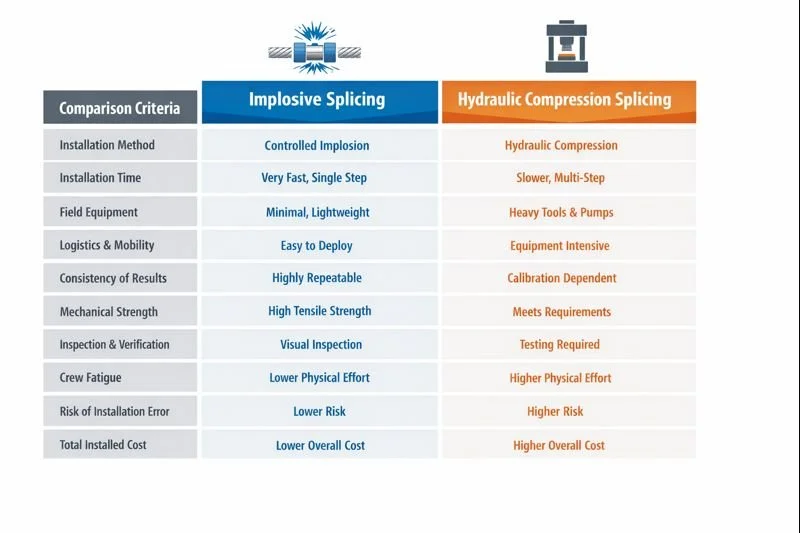
While hydraulic compression has provided reliable performance over many years, it often introduces logistical complexity and higher overall installed costs.
Implosive Splicing: A Modern Alternative
Implosive splicing utilises a pre-engineered sleeve that implodes uniformly around the conductor when activated, creating a secure mechanical and electrical connection. Instead of relying on external mechanical force, the splice is formed through a controlled, rapid process designed to produce consistent results.
Key features of implosive splicing include:
Uniform compression along the entire splice length
Less installation equipment compared to hydraulic systems
Reduced installation time and crew fatigue
Consistent, repeatable performance in the field
Implosive splicing has been successfully implemented on transmission and distribution networks across North America, especially where speed, reliability, and logistical efficiency are priorities.
Advantages of Implosive Splicing Over Hydraulic Methods
Faster Installation - Implosive splicing significantly decreases installation time. Without the need for hydraulic setup and multiple compression passes, crews can complete splices quickly and efficiently.
Reduced Equipment and Logistics - The absence of large hydraulic tools simplifies transportation, staging, and access—especially in remote locations or challenging terrain.
Superior Mechanical Performance - Implosive splices are designed to achieve tensile strength equal to or greater than the conductor itself, ensuring long-term durability under mechanical loads.
Reliable Electrical Performance - The uniform contact between strands results in low electrical resistance and excellent current-carrying capacity throughout the splice’s lifespan.
Simplified Inspection - Since the splice formation process is controlled and repeatable, verification often only requires visual inspection, reducing the need for specialised testing.
Lower Total Installed Cost - When considering labour, equipment, maintenance, and project duration, implosive splicing often leads to measurable cost savings compared to hydraulic compression.
A Proven Solution for Modern Power Systems
As grid infrastructure develops and project timelines become tighter, implosive splicing offers utilities and contractors a modern, field-proven alternative to traditional hydraulic methods. By simplifying installation, improving consistency, and reducing logistical challenges, implosive splicing encourages safer work practices and more efficient project delivery.
For many applications, it represents not just a different way to splice conductors — but a smarter one.
If you are interested in implosive splicing, you might want to learn about Implosive Sleeves Corporation. ISC brings over 30 years of experience in the conductor splicing industry, delivering innovative implosive splicing solutions backed by deep expertise in manufacturing, licensing, logistics, training, and field installation. With a manufacturing facility based in Ontario, Canada, the company supports utilities and contractors with locally produced solutions, hands-on technical support, and proven technology designed for reliable, efficient high-voltage conductor splicing.

